Friday, 13 January 2017

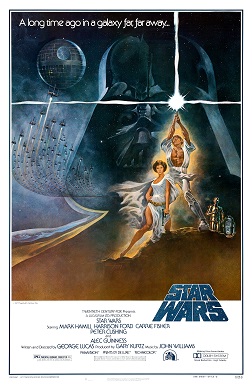
'Star Wars: A New Hope' Review

Image result for star wars a new hope

Director: Geroge Lucas
Cast: Mark Hamill, Harrison Ford, Carrie Fisher, Alec Guinness, Peter Cushing
Release Date: 27 December 1977 (UK)

Summary:
Luke Skywalker joins Jedi Obi-Wan Kenobi, pilot Han Solo and Wookie Chewbacca in an attempt to save the galaxy from the Death Star, the greatest threat ever created, by rescuing Princess Leia who holds the plans for the ship.

A long, long time ago in a galaxy far, far away, George Lucas was inspired by the likes of Kurosawa and Flash Gordon to create the biggest film series of all time. Star Wars: A New Hope was definitively the beginning of an era. Predicted to be a flop, even by its own director, the film made well over $700,000,000 at the box office and established a franchise spanning seven films (nine if you include Clone Wars and Rogue One). Going back to the beginning of it all, it’s easy to understand where this adoration stems from, despite the fact that 2017 marks the 40th anniversary of A New Hope.
At the time of release, there was no single film that transported the audience as Star Wars did.  Lucas established an entirely new world for the audience to discover and, in my opinion, it is the detail and realism with which this universe is created that makes the series so successful. The set pieces are not only incredibly designed; they are worn- lived in. It’s believable as a reality. This world-building combined with Lucas’s graceful camerawork and striking establishing shots hits the audience with an impact that many struggle to match, even now.
The characterisation is also incredibly effective. Lucas takes a similar approach to someone such as Michael Mann and assumes his audience are simply intelligent enough to keep up and fill in the blanks. The film immediately submerges itself in the plot and moves at an extremely fast pace with very little exposition. And this ties in for the characters as well. It takes exactly 1 minute 16 seconds for Han Solo to establish himself as one of the most iconic characters of all time. Chewbacca cannot talk and yet he is one of the most loved creatures in cinematic history. Star Wars doesn’t need specific description or dialogue to establish its characters and that’s a sign of incredible scripting. And how can you discuss any of these films without mention of John William’s iconic score which blends so seamlessly together with the visuals and tonally creates such an impact that the first few notes are immediately recognisable.

Star Wars: A New Hope was the first of its kind. An entirely original fantasy film that composed an entirely new universe and defined the concept of film franchise, it is a film for the generations and will continue to maintain its magic, presumably, forever.

★★★★★

Sunday, 4 December 2016

'Doctor Strange' Review


Director: Scott Derrickson
Cast: Benedict Cumberbatch, Tilda Swinton, Mads Mikkelsen, Chiwetel Ejiofor, Rachel McAdams
Release Date: 25th October 2016 (UK)

Image result for doctor strange

Stephen Strange is one of the world's most successful neurosurgeons on the planet and one of the most arrogant as well. But after an awful car crash leaves him with paralysis in his hands, Strange is left rejected by western medicine and goes out on a whim to Katmandu, Nepal in search of alternative treatment and finds more than he bargained for...


If you’ve heard anything about this film, you’ll have heard the comparisons: the city bending is like Inception, the magic training in Nepal is like Batman Begins and so on. And while these hold merit, in my opinion, it most closely resembles Ant-Man. It's notable at this point that Marvel has a formula. And, don’t get me wrong, it works. Each film from the studio for the past four years or so has found a way to balance comedy, drama and action so that the audience remains enthralled and entertained in a way that DC, for example, are struggling to pinpoint. And this is my main issue with Doctor Strange.

For a film that was marketed as being ‘original’, I found myself recognising the same mediocre villain, the same witty interactions between characters, the same internal debate of morality with the lead character. It’s all just the same. And while, for the moment, this isn’t too much of an issue (I still think the film deserves 3 stars), I’m wondering how long Marvel can keep this up before it becomes entirely tiresome. After all, if this film had been released in 2013, I would have given it four, maybe even five, stars without an issue but I left the screening with the overwhelming sense that I’d seen it all before.

The characterisation also struggles to work. Stephen Strange (Benedict Cumberbatch) is so detestably arrogant at the beginning of the film that you take an immediate dislike to him and he does little to improve this opinion throughout the course of the film. The Ancient One (Tilda Swinton) is, quite frankly, everything you would expect from a character called The Ancient One and the character arc they attempt to squeeze in to give her weight is entirely futile. Kaecilius (Mads Mikkelsen) is generic enough of a villain that he could’ve been Christopher Eccleston’s Malekith from Thor: The Dark World or Lee Pace’s Ronan from Guardians of the Galaxy- both of whom I had to google because their names had been long since forgotten. And Christine (Rachel McAdams) takes the biscuit for the most useless love interest possible- an utter waste of McAdams as an actress.

This lack of development, which is highly surprising from a studio dedicated to making multi-faceted characters, meant a lot of issues elsewhere in the film; there’s a big failure to connect on any emotional level and there were several times that jokes that would have caused heaps of laughter from someone such as Iron Man raised only a few meagre chuckles. As well as this, though the overall CGI was incredible and some of the best work I’ve ever seen, there were moments of green screen that were noticeably off-kilter.


Overall, the film does work. I have focussed mainly on the negatives here but I can’t say that I completely despised it and its definitely not a complete fall from grace for the franchise. However, thought it’s not bad, it’s certainly not the best and, as evident in what can only be described as the WORST Stan Lee cameo ever, it gives the impression of trying a little too hard to be “Marvel”.

★★★☆☆

Monday, 10 October 2016

'Throne of Blood' Review

Director: Akira Kurosawa
Cast: Toshiro Mifune, Isuzu Yamada, Takashi Shimura
Release: 15th January 1957 (Japan) 


'Throne of Blood' is the first of a trilogy of Shakespeare adaptations from Japanese director Akira Kurosawa. Considered one of the greatest directors of all time, Kurosawa transposes medieval Scotland for feudal Japan in his rendition of Macbeth and is considered one of the greatest, most effective Shakespeare adaptations of all time. which effectively emphasizes the tension and horror of the original play. In typical Kurosawa style, the emphasis of the film remains upon the themes of sadness and fear from the original play and the samurai style only emphasises the sense of fear, tension and misplaced masculine pride.

Toshiro Mifune perfectly balances the madness, blind ambition and insecurity of Taketoki Washizu (the Macbeth of the film) that allows us to not only understand the origins of his motives but to sympathise with a character who in many circumstances could be viewed the villain and despite a physically aggressive performance it is potentially the most emotionally charged performance of the character ever. Isuzu Yamada (Lady Asaji Washizu or Lady Macbeth if you will) again approaches the usually aggressive character of Lady Macbeth with a chillingly calm demeanour that is so justified and precise it’s easy to understand her manipulation of such a powerful war general. This in turn only further allows her outbursts of anger and dominance to resonate in the several moments they occur. This is all covered by the haunting score from Masaru Sato and a layer of fog that increases the level of unknown fear and the paranormal elements of spirits.

My issues with the film existed almost entirely with the editing. The pace remained incredibly slow throughout and whilst in places this worked well to provide tension and a sense of dread, it did frequently have shots that lasted far longer than necessary. As well as this, several of the transitions uses swipes and fade to blacks that seem very unnatural for the feudal Japan setting. Cuts usually remain unnoticed by the audience and instead of this adding an interesting, stylistic aspect to the film, I instead found it abrasive and it drew me out of the film.

Overall, some questionable editing choices left my viewing of the film divided and distracting from the story line but terrific acting and haunting visuals emphasised the film’s plot and made it a spectacular adaption of Macbeth.


7/10

Friday, 23 September 2016

Ex Machina Review

For me, Ex Machina was a highly-anticipated film. After receiving rave reviews last year and exhibiting some of the best actors in the world (Oscar Isaac being one of my favourite actors ever), my expectations were extensive to say the least. Caleb (Domnhall Gleeson) is awarded the opportunity to spend a week in the company of Nathan (Oscar Isaac), who is an all out child prodigy technology genius (think an evil Bill Gates). Upon arrival, however, Caleb discovers that what he believed to be Nathan's house is a research facility and he has been brought to test Nathan's latest discovery in artificial intelligence, Ava (Alicia Vikander) and things spiral out of control from there.

Though the film obviously has elements of science fiction, the focal genre is thriller and the contained nature of the solitary facility housed in a rural Norwegian setting emphasises the tension and paranoia that is maintained through the uncomfortable relationships between all characters. Domnhall Gleeson maintains both a sense of gullibility and quiet intelligence that makes the characters morality and actions believable and Alicia Vikander finds the perfect balance between human and robot characteristics to allow Ava to fully be portrayed as AI. Of course, Oscar Isaac, who seemed to make an attempt to be in every good film of 2015 nails Nathan's egotism and deception whilst still never truly becoming an "antagonist" of the film.

This ambiguity of character between all three furthermore adds to the ambiguity of the film as a whole but also prevents any real alliance being made with any character which leaves you somewhat passive to the action that occurs. As well as this, though the film maintains pace and plot throughout and never deviates for pointless moments, when it ends you are left with a sense that more could have been explored whether that was in exposition or character development.

Positives: The film is beautifully shot and the performances are astonishing whilst all maintaining pace without many if any plot holes.

Negatives: The characters are all, in their own way, discreditable and the short run time all leaves a sense that something was missing even though you're not quite sure what.

Summary: Despite not liking many characters, Ex Machina is a fantastic film and definitely worth anyone's time.

9/10

Tuesday, 20 September 2016

8 Days A Week Review

8 Days A Week is a documentary that focuses on the times of 'Beatlemania'- the touring days of The Beatles exploring their first visit to America, their iconic performance at Shea Stadium up until their disillusion with live performance that led into their experimental recording work. Ron Howard works towards a light hearted approach to the story- which with the addition of the Beatles infamous sarcasm and dry humour- works perfectly to highlight the shock of the experience whilst also preventing the negative moments from being too dark.

This is simultaneously an issue and a grace as whilst it maintains the tone of the film, you're left with the sense that every aspect of the story has yet to be been explored (and considering the heavy involvement of the remaining Beatles themselves AND the production from the Beatles company, it's easy to understand why we never experience a less than positive light). The use of unseen footage, interviews with fans and interviews with celebrities (the likes of both Sigourney Weaver and Oprah Winfrey both make appearances) does maintain a positive feeling however and I could see how, though this film does not explore anything particularly unknown to people who are aware of The Beatles story, it would still be enjoyable for fans wanting to remember or experience the concerts for themselves. 

Positives:
The documentary is enjoyable, fun and provides the perfect blend of music, interviews and humour to create an enjoyable watch.

Negatives:
It provides nothing truly new enough or scintillating enough to be considered a "great" documentary and feels like it leaves a lot unexplored.

Summary:
While not the most awe-inspiring music documentary in the world, it is still thoroughly enjoyable and definitely something to watch for if you're a fan of the Fab Four.

Thursday, 15 September 2016

Ran Review

Image result for ran poster


Being that I am someone who is considering a degree in Film Studies, I thought it an educated decision to educate myself on Akira Kurosawa. Being considered one of the greatest directors from Japan (or the world in general), my expectations for Ran were high, to say the least. Ran is Kurosawa's adaptation of Shakespeare's 'King Lear' exchanging the English setting for a classic samurai format in rural Japan and Lear's three daughters for three sons which in turn emphasises the brutality of the story.

We see as Lord Hidetora (Tatsuya Nakadai) after a life spent dominated by war and political turmoil, separates his yield between his threes sons, distributing his first castle to his first son and so on. Saburo (Daisuke Ryu), his youngest, disagrees with this decision, not due to spite, but due to his disbelief in his brother's ability or loyalty which furthermore leads to his banishment. The country then spirals into civil war through the older brother's deceit and greed leading to Hidetora's descent into madness. The film is considered to be one of Kurosawa's greatest works and it's easy to understand why. Though it does contain all the regular tropes of a Shakespearean tragedy (excessive death, manipulation, deceit etc.), Kurosawa's emphasis on brutality and sense of realism adds a depth and level of terror to the King Lear tale that only emphasises the true horror of the actions taken.

Tatsuya Nakadai gives a spectacular performance as the Great Lord- his theatrical energy emphasises his spiralling downfall but also highlights the key moments of genuine emotion that allow the audience to feel genuine compassion for him despite the effects being largely down to his own inflated sense of ego and power. Visually, the film is stunning- Kurosawa using the primary colours to represent each brother respectively to create a visual clash that corresponds with the bloody action. One scene, in particular, plays out for an extensive period and the excessive nature of the battle juxtaposed with only the sound of the beautiful score by Toru Takemitsu balances the perfect levels of fear and horror at the visual scenery but leaves the audience still with a sense of betrayal and sadness. The film also ends on a very simple shot that fully summarises the hopelessness and futility of the events and prevents the audience from achieving a sense of catharsis which is palpable as the credits proceed.

Positives: Kurosawa really excels with this- the visuals, scripting, acting and score all coming together into a perfect blend that invigorates the original story into something much darker and full of horror.

Negatives: The only potential issue I could find is that it's maybe not a story for everyone- the plot is thick and intense and the length of 2hr42mins may be off-putting to some, though, in my opinion, it is truly worth the watch.

10/10

Sunday, 11 September 2016

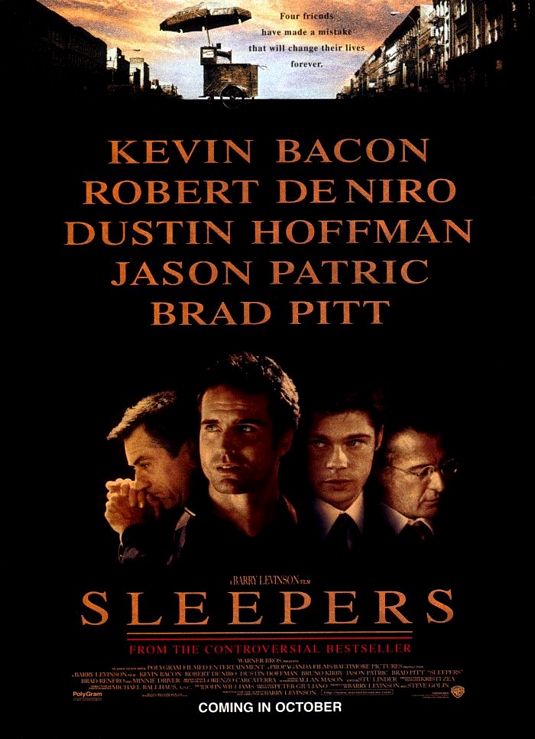
Sleepers Review

Image result for sleepers film poster

When it comes to films, my personal philosophy is that the optimum way to enjoy the story is to know almost nothing about what you’re watching. The less you know, the more immersive your experience becomes, unaffected by other’s opinions and previous knowledge. This is precisely how I entered Sleepers- with nothing more than my mother’s recommendation and a slight awareness of the cast.

The film follows four young boys, who after a serious altercation with a stolen hot dog cart, are sent to boy’s reform school where they are physically and sexually abused by several guards, specifically Nokes (Kevin Bacon) who appears to embody all concepts of definite evil. 11 years later, the boys are still struggling to cope with their horrors which, for the sake of avoiding spoilers, leads them to revenge and a series of courtroom battles.

One of the major themes of the film is the concept of morality and Robert De Niro provides a fantastic subdued performance as Father Bobby, a man faced with a choice between honesty and protecting the boys of his clergy. Again, Dustin Hoffman works somewhat as comedic relief in the film as a drunken lawyer hired simply for his ability to comply and while Rain Man or Kramer vs Kramer, Hoffman remains in good form and provides an efficient and entertaining performance.

The first act and second acts of the film are where it really excels, by maintaining a strong pace and creating an emotional connection with the young boys that allows the audience to forgive their mischievous nature and truly be disgusted and appalled by some of the abuse scenes. However, the film really begins to slow in its third act, with several plot holes and a lack of attention to detail, and while it still remains enjoyable, the 2hr27min run time seems to drag somewhat.


Positives:  The film offers some really great performances in the shape of not only De Niro and Hoffman but also the young boys and truly finds its strengths within the first act.

Negatives: Towards the end, a few plot holes begin to develop and the portrayal of the boys all grown up is somewhat lacking in comparison to the younger counterparts.

Summary: The film remains enjoyable throughout despite the excessive run time and despite a decline in structure towards the end, at no point does it become dull and remains an entertaining watch.


7/10