Friday, 23 September 2016

Ex Machina Review

For me, Ex Machina was a highly-anticipated film. After receiving rave reviews last year and exhibiting some of the best actors in the world (Oscar Isaac being one of my favourite actors ever), my expectations were extensive to say the least. Caleb (Domnhall Gleeson) is awarded the opportunity to spend a week in the company of Nathan (Oscar Isaac), who is an all out child prodigy technology genius (think an evil Bill Gates). Upon arrival, however, Caleb discovers that what he believed to be Nathan's house is a research facility and he has been brought to test Nathan's latest discovery in artificial intelligence, Ava (Alicia Vikander) and things spiral out of control from there.

Though the film obviously has elements of science fiction, the focal genre is thriller and the contained nature of the solitary facility housed in a rural Norwegian setting emphasises the tension and paranoia that is maintained through the uncomfortable relationships between all characters. Domnhall Gleeson maintains both a sense of gullibility and quiet intelligence that makes the characters morality and actions believable and Alicia Vikander finds the perfect balance between human and robot characteristics to allow Ava to fully be portrayed as AI. Of course, Oscar Isaac, who seemed to make an attempt to be in every good film of 2015 nails Nathan's egotism and deception whilst still never truly becoming an "antagonist" of the film.

This ambiguity of character between all three furthermore adds to the ambiguity of the film as a whole but also prevents any real alliance being made with any character which leaves you somewhat passive to the action that occurs. As well as this, though the film maintains pace and plot throughout and never deviates for pointless moments, when it ends you are left with a sense that more could have been explored whether that was in exposition or character development.

Positives: The film is beautifully shot and the performances are astonishing whilst all maintaining pace without many if any plot holes.

Negatives: The characters are all, in their own way, discreditable and the short run time all leaves a sense that something was missing even though you're not quite sure what.

Summary: Despite not liking many characters, Ex Machina is a fantastic film and definitely worth anyone's time.

9/10

Tuesday, 20 September 2016

8 Days A Week Review

8 Days A Week is a documentary that focuses on the times of 'Beatlemania'- the touring days of The Beatles exploring their first visit to America, their iconic performance at Shea Stadium up until their disillusion with live performance that led into their experimental recording work. Ron Howard works towards a light hearted approach to the story- which with the addition of the Beatles infamous sarcasm and dry humour- works perfectly to highlight the shock of the experience whilst also preventing the negative moments from being too dark.

This is simultaneously an issue and a grace as whilst it maintains the tone of the film, you're left with the sense that every aspect of the story has yet to be been explored (and considering the heavy involvement of the remaining Beatles themselves AND the production from the Beatles company, it's easy to understand why we never experience a less than positive light). The use of unseen footage, interviews with fans and interviews with celebrities (the likes of both Sigourney Weaver and Oprah Winfrey both make appearances) does maintain a positive feeling however and I could see how, though this film does not explore anything particularly unknown to people who are aware of The Beatles story, it would still be enjoyable for fans wanting to remember or experience the concerts for themselves. 

Positives:
The documentary is enjoyable, fun and provides the perfect blend of music, interviews and humour to create an enjoyable watch.

Negatives:
It provides nothing truly new enough or scintillating enough to be considered a "great" documentary and feels like it leaves a lot unexplored.

Summary:
While not the most awe-inspiring music documentary in the world, it is still thoroughly enjoyable and definitely something to watch for if you're a fan of the Fab Four.

Thursday, 15 September 2016

Ran Review

Image result for ran poster


Being that I am someone who is considering a degree in Film Studies, I thought it an educated decision to educate myself on Akira Kurosawa. Being considered one of the greatest directors from Japan (or the world in general), my expectations for Ran were high, to say the least. Ran is Kurosawa's adaptation of Shakespeare's 'King Lear' exchanging the English setting for a classic samurai format in rural Japan and Lear's three daughters for three sons which in turn emphasises the brutality of the story.

We see as Lord Hidetora (Tatsuya Nakadai) after a life spent dominated by war and political turmoil, separates his yield between his threes sons, distributing his first castle to his first son and so on. Saburo (Daisuke Ryu), his youngest, disagrees with this decision, not due to spite, but due to his disbelief in his brother's ability or loyalty which furthermore leads to his banishment. The country then spirals into civil war through the older brother's deceit and greed leading to Hidetora's descent into madness. The film is considered to be one of Kurosawa's greatest works and it's easy to understand why. Though it does contain all the regular tropes of a Shakespearean tragedy (excessive death, manipulation, deceit etc.), Kurosawa's emphasis on brutality and sense of realism adds a depth and level of terror to the King Lear tale that only emphasises the true horror of the actions taken.

Tatsuya Nakadai gives a spectacular performance as the Great Lord- his theatrical energy emphasises his spiralling downfall but also highlights the key moments of genuine emotion that allow the audience to feel genuine compassion for him despite the effects being largely down to his own inflated sense of ego and power. Visually, the film is stunning- Kurosawa using the primary colours to represent each brother respectively to create a visual clash that corresponds with the bloody action. One scene, in particular, plays out for an extensive period and the excessive nature of the battle juxtaposed with only the sound of the beautiful score by Toru Takemitsu balances the perfect levels of fear and horror at the visual scenery but leaves the audience still with a sense of betrayal and sadness. The film also ends on a very simple shot that fully summarises the hopelessness and futility of the events and prevents the audience from achieving a sense of catharsis which is palpable as the credits proceed.

Positives: Kurosawa really excels with this- the visuals, scripting, acting and score all coming together into a perfect blend that invigorates the original story into something much darker and full of horror.

Negatives: The only potential issue I could find is that it's maybe not a story for everyone- the plot is thick and intense and the length of 2hr42mins may be off-putting to some, though, in my opinion, it is truly worth the watch.

10/10

Sunday, 11 September 2016

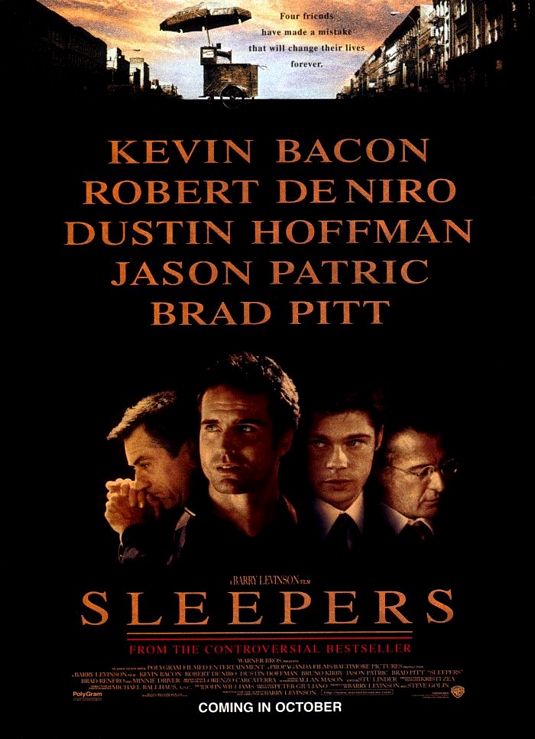
Sleepers Review

Image result for sleepers film poster

When it comes to films, my personal philosophy is that the optimum way to enjoy the story is to know almost nothing about what you’re watching. The less you know, the more immersive your experience becomes, unaffected by other’s opinions and previous knowledge. This is precisely how I entered Sleepers- with nothing more than my mother’s recommendation and a slight awareness of the cast.

The film follows four young boys, who after a serious altercation with a stolen hot dog cart, are sent to boy’s reform school where they are physically and sexually abused by several guards, specifically Nokes (Kevin Bacon) who appears to embody all concepts of definite evil. 11 years later, the boys are still struggling to cope with their horrors which, for the sake of avoiding spoilers, leads them to revenge and a series of courtroom battles.

One of the major themes of the film is the concept of morality and Robert De Niro provides a fantastic subdued performance as Father Bobby, a man faced with a choice between honesty and protecting the boys of his clergy. Again, Dustin Hoffman works somewhat as comedic relief in the film as a drunken lawyer hired simply for his ability to comply and while Rain Man or Kramer vs Kramer, Hoffman remains in good form and provides an efficient and entertaining performance.

The first act and second acts of the film are where it really excels, by maintaining a strong pace and creating an emotional connection with the young boys that allows the audience to forgive their mischievous nature and truly be disgusted and appalled by some of the abuse scenes. However, the film really begins to slow in its third act, with several plot holes and a lack of attention to detail, and while it still remains enjoyable, the 2hr27min run time seems to drag somewhat.


Positives:  The film offers some really great performances in the shape of not only De Niro and Hoffman but also the young boys and truly finds its strengths within the first act.

Negatives: Towards the end, a few plot holes begin to develop and the portrayal of the boys all grown up is somewhat lacking in comparison to the younger counterparts.

Summary: The film remains enjoyable throughout despite the excessive run time and despite a decline in structure towards the end, at no point does it become dull and remains an entertaining watch.


7/10